Showing posts with label Best Picture. Show all posts

Sunday, August 7, 2011

Cimarron


Cimarron (released February 9, 1931)
Director: Wesley Ruggles
Starring: Richard Dix, Irene Dunne, Estelle Taylor, Roscoe Ates
Produced by: William LeBaron
Written by: Howard Estabrook (based on the novel by Edna Ferber)
Music by: Max Steiner
Cinematography by: Edward Cronjager
Distributed by: RKO Pictures


Context This


Eighty years is a long time, especially in the film industry. This amount of time has great impact on attitudes, cultural references, technological advances, and the collective memory of those who watch movies.

Cimarron won for Best Picture for the Academy Awards for 1930-31. I would imagine most people my age have never heard of it. Most of the people who saw it in the theaters are dead. Certainly everyone who was in it is dead. Today's world has almost no memory of this film that was judged to be the best of the best for that year.

But there are other movies from that year that are more memorable today than Cimarron. For instance, the 1930-31 span also produced two rather famous pictures: Little Caesar (with Edward G. Robinson) and Public Enemy (with James Cagney). Neither one was even nominated for Best Picture (or Best Actor) but both make a stronger mark in time than Cimarron has.

Sabra Cravat has that "Get me the @#$% out of here" look.
The movie was based on Edna Ferber's book by the same name. Turning books into movies has certainly been a phenomenon that has been with us since the beginning of motion pictures. The story follows the trials and tribulations of the Cravat family as they make their way from Witchita into the new territory of Oklahoma. Yancey and Sabra Cravat (played by Richard Dix and Irene Dunne) are a young couple who are suffocating under her well-to-do family's thumb. They move to the upstart town of Osage, OK where Yancey starts the town's newspaper, the Oklahoma Wigwam. The Cravats face all sorts of challenges with the riff raff and gunslingers that are drawn to the new boomtown. I was astonished at the shooting skills of all. Why Yancey himself draws his pistol and shoots from the hip, intentionally grazing the ear of Lon Yountis, the baddest, meanest outlaw Osage had to offer.

Watching this movie out of context would make one wonder just what the hell was the Academy thinking? The acting was overly melodramatic. But the film industry had only just moved out of silent pictures into the realm of talkies. Acting needed to be overblown in the silents to compensate for the lack of speech. Also, because sound had been so recently introduced, the technology wasn't advanced enough to give the quality we are used to to day with our Dolby 6.1 surround sound. Sometimes words were muffled, and no matter how high you turned up the volume, some words were just lost.

Sabra's domestic bliss lasts about three seconds beyond this point.
The story was still interesting. Spanning 40 years, we see the young family torn apart my Yancey Cravat's wanderlust and inability to stay in one place. Yancey actually abandons his family for five years in his quest for adventure. Then when he comes home he expects his family to welcome him with open arms. His children do, but his wife is torn between her relief at seeing him again and ripping his head off. She lets relief win, but Irene Dunne, I felt, did an admirable job of conveying that struggle within Sabra.

I do find it interesting that this story had such a mix of modern and antiquated ideology. On the one hand, the script makes no bones about putting down Indians, Blacks, and Jews. And yet the close of the movie sees Sabra Cravat being elected the first female Congresswoman to represent the State of Oklahoma in Washington. Even so, Yancey Cravat himself defends a prostitute in court, and has very tolerant ideas about Indians for a man of his time. Although I did notice he speaks of the Indians being robbed of their land, and yet takes part in the land rush to claim a bit of it for himself.

There were some rather comical parts. The first scene in the Venable home in Witchita (the childhood home of Sabra) we see a dining room scene briefly before it focuses in on one of the characters. I saw it and my brain did a "what the HELL was that?" It looked like there was a human being suspended above the table in a cage. And I was wondering if all those rumors about what dirty things the Victorians got up to behind closed doors was true.
When the camera cuts back to the whole table I see in fact my brain wasn't entirely wrong. There was a human suspended above the table. A young black boy named Isaiah was laying on a platform up near the ceiling, fanning the folks seated below with a large feather fan.

Wow. I can see why TCM doesn't have this one it its rotation. It was almost like a scene out of Blazing Saddles, only without the irony.

However, coming away from this film, I can see why it won over other films. There are some very high-brow themes that run through this picture that the Academy would love, even back then. Ideals like progress, pioneer spirit, and success through hard work are freely strewn through the picture. At the end, however, I felt the movie was less about Yancey and his freewheeling spirit, and more about Sabra and her constancy that were the foundation of this story. She comes out the real hero in the end.

That said, I've seen both Public Enemy and Little Caesar, and the writing in either script totally outstrips Cimarron's. I wondered why on earth Cimarron was nominated in nearly every category, while the other two pictures scored only one nomination each, and won nothing? And then I learned about "The Code."

The Academy didn't have the cajones to recognize real talent.
For those of you who may not know, a code of censorship guidelines was imposed on the production of movies in 1930, although it was not rigorously enforced until 1934. These codes restricted the portrayal of violence, crime, vice, drug use, and all sorts of nefarious activities. Both Public Enemy and  Little Caesar were both pictures that flouted the rules set forth in the code, portraying organized crime in a very favorable light. I would imagine then, that the MPAA couldn't go ahead and award these movies for blatantly ignoring the code it had just adopted.

Like The Greatest Show on Earth, we again find a film that won because of politics and not on its own merit.

~Anna

He’s no Stay-at-home Dad

I found it interesting that Edna Ferber’s historical novel, Cimarron, was brought to the screen only a couple of years after the book’s release. This would lead me to believe there was plenty of interest generated in the story of the late nineteenth century land rush for the Oklahoma Territories. Really? I guess that’s what people were into back in the early ’30s. Or maybe with the Great Depression starting to pick up a head of steam Americans were desperate to flock into movie houses and watch anything that took their minds off the worsening world outside the theaters. Still and all I don’t wish to bash this picture straightaway. Truth is I actually enjoyed it more than I thought. I should add that I did so with the same sort of quaint and slightly amused interest one would study an ancient Model T Ford.

Tedium: Film at eleven.
To a greater or lesser extent all movies are creatures of their times. They reflect the fashion, social mores and habits of speech that were prevalent at the time of their production. This might seem like a belabored point here, but as we re-watch this movie from a widening gap of eighty years, we might bear in mind the maxim of the Greek philosopher, Heraclitus who stated: “Noting is more constant than change.” And things certainly have changed since this motion picture hit the screens. The science of film-making has obviously advanced and it is evident throughout the picture. Camera angles and shots seem rather staid, stilted and stagy to a degree. A good example is the justly famous beginning shots of the picture that represent the start of the land rush. It is written that over five thousand extras and twenty-eight cameramen were used to film this sequence which for its time must have had a tremendous effect on audiences. Watched today however, it dissolves into a rather tedious elongated scene (2 min, 7 sec) of racing wagons bouncing across the prairie. The sheer numbers of them however is still mighty impressive.

Darling, someday your descendants will invite
everyone home for milk and cookies.
We are constantly reminded that we are not too distant from the stage while watching each scene unfold. The actors, in particular Richard Dix who portrays Yancey Cravat, tend to overplay for the camera. Coming from the stage and silent pictures, it must have been difficult at first for the players to tone down their exaggerated mannerisms which would have been expected of them when treading the boards where such things were embellished for the benefit of audience members seated in the back row. Acting in silent movies would have also added to the inflated gesticulations as now words could be used to communicate characters’ thoughts instead of overblown reactions. Thus Dix as Yancey hams it mightily through his scenes and in truth, makes an enjoyable time of it for the modern-day audiences. And excuse me for saying, but am I the only one who thinks I am looking at the spitting image of the late comic actor, Andy Kaufman when we first set eyes on Yancey Cravat in the saddle sporting his white hat? It’s almost scary how much they look alike. I was also amazed to see who I thought was Carol Burnett in the role of the prim and proper Mrs. Tracy Wyatt, played by Burnett look-a-like, Edna May Oliver. Wow!

Yancey Cravat is introduced to us as part of the thousands ready and willing to carve out their little piece of America at the beginning of the land rush. His character is thus set for the rest of the picture. Restless and eager to push on, he is the embodiment one supposes, of the great pioneering spirit of the late nineteenth century. Well, he might fill that role admirably, but he certainly makes a piss-poor husband and father. At one point in the middle of the story, his wanderlust hits him bad and he lights out, leaving his poor wife, Sabra (played by Irene Dunne) to mind the children and the family business (running the newspaper: The Oklahoma Wigwam) back in the burgeoning town of Osage. Whatta jerk! Of course, throughout the movie one has hints that before he married, Yancey was running with bandits and having a wild time of it in the rather ambiguous territory named Cimarron. I assume then we are to regard Yancey as a sort of lovable rogue, not willing to be tied down to anything as frivolous as a wife and two children. That is truly the only way you can look at his character in the light of how he is portrayed throughout the film.

Yancey Cravat: Piss-poor husband and a fantastic shot.
His handling of the riff-raff in Osage, and in particular the evil Lon Yountis (you gotta love these names!) is priceless. The leading men of the town chose Yancey to give a sermon at the first meeting of the Osage Methodist Church. Since the town hasn’t got a proper house of worship built yet, the meeting is conducted in Grat Gotch’s Hall of Chance, a gambling tent – the only place in town big enough to house the event. Yancey shows up in the guise of a pistol-packin’ padre, Bible in one hand and six-shooters firmly holstered. In the middle of his sermon, he must gun down Lon who stands in the back and tries to shoot him first. One watches these scenes with an open jaw…

Great Balls of Fire! Even Jerry Lee Lewis would have
been impressed with that head of hair.
There are numerous subplots enmeshed throughout the picture and in one of them, Yancey has to defend a whore with a heart-of-gold. While he makes his case (because of course in addition to being a pseudo-preacher and newspaperman, he is a former practicing lawyer too) I dare anyone to try and concentrate on his plea while concurrently watching the ridiculous ball of hair clinging to the right side of his temple become a living thing; bobbing and tossing about with abandon while below its owner chews up the scenery. Egad, but that’s some unintentionally funny stuff. Now since I’ve waxed poetic on noses [All the King’s Men] and teeth [The Last Emperor], I feel I should say something about Yancey’s hair. What in the hell is that all about?! Huge hanks of it flow out from both sides of his head and at times makes him look like he’s sporting goat horns. Was this the style back then? Frankly, I can’t see when this type of coif would ever be in style.

This movie is never going to receive an NAACP picture award due to its rather cavalier handling of minorities. Actor Eugene Jackson’s portrayal of Isaiah, the Cravat family’s young black retainer is filled with the accepted mugging for the camera and comic relief such characters were expected to provide eighty years ago. It must drive the PCers of today plum crazy. However in the moviemakers’ defense, several times throughout the film Yancey is portrayed as a character sympathetic to the Indians’ plight and by the end of the picture, his son has taken on a Native American wife.

While Yancey runs off for years-on-end to do his thing, Sabra must fend for the family and in doing so ends up a much stronger character than her husband. Her iron will and perseverance rewards her by the end of the movie with a seat in Congress! At the close of the picture we meet Yancey for the final time. In the succeeding years he has turned into a drifter hanging around the oil fields that have everywhere sprung up in the state of Oklahoma. Why he would leave a loving family to end up like this we are never properly told. However we are described his heroism as it is his selfless action that saved the lives of the oil men working around a rig that unexpectedly gushed, sparing them but mortally injuring him. Sabra upon hearing this, rushes to her dying husband and cradles his head in her arms as he utters his final words to her: “Wife and mother… stainless woman. Hide me in your love.” Quick, grab your hanky.

Touted as the “first Western” to earn an Academy Award, Cimarron is an interesting piece of history that must in part be watched as such in order to properly understand it.

--kak

Next up: How Green Was My Valley (1941)

Sunday, July 24, 2011

Rain Man


Rain Man (released December 16, 1988)
Director: Barry Levinson
Starring: Dustin Hoffman, Tom Cruise, Valeria Golino
Produced by: Mark Johnson
Written by: Barry Marrow, Ronald Bass
Music by: Hans Zimmer
Cinematography by: John Seale
Distributed by: United Artists

Faulty Memories


Last week we pulled Rain Man out of the box. Ever since then I’ve had that song in my head. You know the one: “My grandma and your grandma sittin’ by the fire…” It’s been there all week, and to be honest, I was never a big fan of it. It does take me back though, to my freshman year of high school. Huh. Maybe that’s why I don’t like the song. But that’s a story for the shrink, not for you.

You're so vain... you probably think
 this movie's about you...
Regardless of what was going on in my life during the Christmas season of 1988, the movie certainly does reflect the late 80s with flair. Like The French Connection, this movies is defined by its decade. Only this time instead of the gritty hideousness of the ugliest decade of the 20th century, we have images of the “Me” decade. And Charlie Babbitt (played by Tom Cruise) is the epitome of that ideal.

Charlie imports fancy sports cars in Los Angeles, wears expensive suits, and has a modelesque Italian girlfriend. Watching this movie now, the character of Charlie reminds me sharply of Cruise’s performance in the movie Jerry Maguire. He played both parts so spot on I wonder if this is “his” role, much like Mel Gibson seems to gravitate towards playing characters hell-bent on revenge. Charlie Babbitt is ruthless, slimy, and overly concerned with his image. He suppresses all emotions except anger. He’s a prick.

Not exactly Thelma and Louise...
The ubiquitous monkey wrench is thrown when his father dies, leaving all the $3 million estate to his brother Raymond (played by Dustin Hoffman) , an autistic savant who doesn’t understand the concept of money. Charlie didn’t even know Ray existed. Ray had been sent to live in Walbrook, a mental institution in Charlie’s hometown of Cincinnati. When Charlie visits Ray he coerces him into the car (a 1949 Buick Roadmaster convertible – Charlie’s inheritance) and takes off. He thinks he can trade Ray for his half of the money, so he sets out for California.

Charlie’s life quickly implodes on the road. His business goes bust from the absence of his fine machinations (i.e. his gift of keeping his customers hanging on through bullshit), his fiancée leaves after she realizes his motivations for keeping Ray, and Raymond himself proves to be extremely hard to handle. A slave to his routines and rituals, Ray must watch The People’s Court every day, eat with toothpicks instead of a fork, and a whole host of other things to keep him comfortable and not pitching a screaming fit.

Susanna: "How was it?" Raymond: "Wet."
I’ve seen a lot of Dustin Hoffman’s films, and I think he’s an amazing actor. From The Graduate, to Tootsie, to Kramer vs. Kramer, he never fails to find a new and interesting role to play, and he plays them incredibly well. Hoffman won the Best Actor Oscar for his role in Rain Man, and it is easy to see why. His portrayal of Raymond Babbitt is so convincing, I forgot he was Dustin Hoffman. That, in my opinion, is the hallmark of a great actor.

My original impressions of this movie as a fourteen-year old were this was a great movie. What wasn’t to love? It had hot Tom Cruise (who had just rocketed to stardom on the con trail of Top Gun). It was funny (“K-Mart sucks” anyone?) and it even had the glitter of Las Vegas thrown in towards the end.

Los Angeles: the new city of Brotherly Love
Watching it last night left me feeling very different. Instead of funny and clever, I now find it to be sad and rather depressing. Tom Cruise’s character is no longer hot, but a rather pathetic jerk with shiny pants and too big hair. (Could someone get him a tie, please?) The movie is no less commanding, maybe more so now that I see it from an adult’s eyes. I can see now the finer subtleties that were lost on me as a newly minted teenager. Charlie’s character does shift from callous bastard to caring brother, but he still retains his self-centered attitude. Being pushed out of his comfort zone, Ray does make progress in learning to connect with people.

Rain Man is certainly not a light and happy movie. However, it does for really the first time bring to light the nature of autism. I didn’t know what autism was before this movie, did you? I’m telling you as a librarian, we buy just as many books about that as we do cancer these days. I believe this movie was instrumental in bringing autism out of the murky shadows of mental illness and defining it for the general public.

Now if I could just get that damn song out of my head.


~Anna


Not Your Typical Buddy Film

     Hollyweird be thy name...
My initial reaction to seeing Rain Man is a mixed one. While I can imagine pitching this idea to producers may have been an interesting and exciting exercise, I would have liked the end result to have been somehow… different. The film’s overwhelming positive reviews and acceptance notwithstanding, I found the story a bit too forced in some scenes. I wonder how many people think of Tom Cruise’s role as the selfish and driven Charlie Babbitt a stretch for him. I for one must admit that under the influence of his recent behavior I could not cozy up to his character, even at the end of the film where he apparently has seen the light and accepts his new-found autistic brother, Raymond (Dustin Hoffman). It’s probably not in my best interest to critique a performance with all of the actor’s personal off-screen baggage influencing me, but there it is. The make-believe Hollywood and its actors and the real-life Hollyweird and its denizens are oft times difficult to keep apart.

It's not easy being an unfeeling ass.
An example of a less than believable scene was near the beginning of the movie in Charlie’s “auto sales office”. I realize the reason for filming it was to establish Charlie Babbitt’s odious character, but the conversations on the headsets sounded a bit too forced to me. Throughout the road trip, Charlie’s rather easy acceptance of Raymond’s decidedly annoying and difficult tantrums seemed unrealistic, although perhaps he was keeping that "thought of half of his late father’s 3-million dollar inheritance in the back of his mind. Overall, I sensed Cruises’s portrayal of Charlie was lacking that last little bit of umph to make me a believer, and him a truly sympathetic character. Their final scene together at the table when the doctors leave the room was something that worked and should have been exploited more.

The cast-list at the end of the film was of interest as it contained the names of a number of doctors who were “consulted” in helping the producers create the character of Raymond Babbitt. Of course, in Dustin Hoffman’s hands, the character of the idiot savant was adorable and interesting. And as this was written as a “feel good movie” firmly in mind, how then can the portrayal be otherwise? Still, one wonders how many people could survive that same trip in the real world and come out the other side wholly sane. Or would they have succumbed to the awful temptation of murdering poor Raymond and dumping his body in a ditch somewhere between Cincinnati and Los Angeles just for a little peace and quiet.

Still waters run deep.
Their brief foray into Las Vegas contained what I thought was the best shot of the entire picture.  It included the long-held close up of Raymond’s face as he sits at the card table and becomes a study in stillness. Director Barry Levinson brilliantly chose to move in very slowly with the camera as in the background, we hear unabated, the hustle and bustle of the rest of the casino which in turn accentuates what Raymond, unbeknownst to anyone else, is doing. That Hoffman can put so much acting into a still face is amazing. His eyes glaze over and you can almost “hear” him counting those cards. It was a very subtle yet bravado piece of acting.

Overall, while I can applaud the idea behind the story and film, its final execution seemed to lack a certain finishing touch, for want of a better term. And in the back of my mind I wonder how much the fact of portraying a dysfunctional character in a sympathetic manner played into the balloting decisions of the Academy members. At times, Hollywood can be awfully touchy-feely.

--kak


Up next: The Last Emperor (1987)

Sunday, July 17, 2011

An American in Paris


An American in Paris (released October 4, 1951)
Director: Vincente Minnelli
Starring: Gene Kelly, Leslie Caron, Oscar Levant, Georges Guétary, Nina Foch
Produced by: Arthur Freed
Written by: Alan Jay Lerner
Music by: George Gershwin (music), Ira Gershwin (lyrics), Saul Chaplin (uncredited)
Cinematography by: Alfred Gilks, John Alton (ballet)
Distributed by Metro-Goldwyn-Mayer


Joie de vivre in Gay Paree

Please excuse me while I don my sou’wester and grab for my umbrella as it seems to be raining romantic musical comedies around here at the Oscar Boot Camp. An American in Paris was pulled out of the box earlier this week and so Anna and I dutifully set up the machine and sat down together to watch Gene Kelly singin’ in the clear skies of Paris.

It was a showstopper a minute...
I was pleasantly surprised to discover this film was a joyous paean to life and love played out in the French capital which by the way looked much more realistic than the ersatz streets of London in My Fair Lady. But perhaps this is attributable to the fact that MGM was not averse to putting on such cinematic extravagances while Warner Bros. was not normally in the business of budgeting elaborate, musicals.

The plot to this picture, such as it is, is certainly no elaborately twisting Hitchcockian mystery, set up to keep the viewer guessing till the very end. In fact, scriptwriter Alan Jay Lerner concocted the barest storyline upon which to hang the marvelous music of the Gershwins and the dancing prowess of Gene Kelly. The fact that it worked and moreover won the coveted Best Picture award is a testament to the talents involved. 

I can almost always tell an MGM picture from this period because of the unabashed saturation of color and the bright lighting under which it is filmed. An American in Paris is no exception. It’s a veritable feast for the eyes with an inherent brightness to it that seems to make everything you’re watching bigger than life.

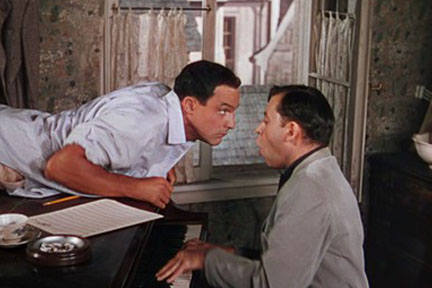
Gene Kelly as the happy starving artist.
There is certainly exuberance to Jerry Mulligan’s character, played with such joie de vivre by Gene Kelly. Without a doubt he has to be the most cheerful starving artist in all of Paris. His perfect foil is his friend, Adam (Oscar Levant) an equally struggling artist who dreams of playing the concert piano. He is the wisecracking contrarian through whom Mulligan learns of the young French girl Lise, played by Leslie Caron in her film début. If there is any depth to the plot, it is to be found here with Lise falling for Jerry who in turn falls for her while concurrently being wooed by society woman, Milo Roberts (Nina Foch) who wishes to sponsor Jerry’s paintings. But Lise is engaged to Henri a cabaret singer played by Georges Guétary. Unwittingly then, Henri and Jerry are after the same girl. Ooo-la-la!

Jerry and Adam tra-la-la-ing in Adam's garret apartment.
While everything is sewn up rather quickly but unconvincingly during the last minute of the movie -- is Henri really smiling while he watches Lise leave his cab for Jerry waiting for her at the top of the steps? Whatta chump! -- the real reason the film is a hit is of course because of the music and dancing. Kelly does things with his feet and body that look so effortless and natural one almost believes he always moved that way. The amusing little vignette at the beginning where he “rearranges” his tiny garret apartment from his sleeping quarters to his living quarters is a gem. The musical/dance numbers come fast and furious in this picture, and one should pay special attention to the fluid camera work in the “Tra-la-la” sequence. And there is something very cool about lighting those stair risers during the “I’ll Build a Stairway to Paradise” number, as Henri ascends them.

The final big number choreographed to Gershwin’s “An American in Paris” serves as the highlight of the picture. It is interesting to note the use of Caron’s ballet movements interspersed with Kelly’s natural dancing and how they made it work.

A worthy Best Picture winner for 1951, I still can’t for the life of me comprehend how the Academy offered a similar statuette to the next year’s winner: The Greatest Show on Earth!

--kak


Gene Kelly est très chaud


Yes, please...
Gene Kelly is hot. Never was there such a manly man to dance on the big screen. I read a brief bio on Kelly (we share the same birthday!) and he said his Mom made him and his brother take dance lessons when they were boys. They quit because the other kids called them sissies. But he said he went back to dance class at fifteen because he discovered it 
was a great way to get girls.


We watched An American in Paris last night. I’d never seen it before, nor did I even know what it was about except, well, Americans in Paris.

The story centers around Jerry Mulligan (Kelly) who stays in Paris when he gets out of the service after World War II. He decides he wants to try his hand at painting and reasons the best place in the world to do this is Paris. He lives in a tiny garret apartment next door to his buddy Adam Cook (played by composer and actor Oscar Levant), another American and concert pianist who is always preparing for a concert, but never actually performs. They are both scraping to make ends meet and living the starving artist lifestyle.

Ms. Roberts checks out the merchandise... and the paintings.
There are two central plots that intertwine in this film. One is about Jerry, his art, and the wealthy patroness that wants to keep him in her pocket. The other is about Lise (the debut for pixie-faced Leslie Caron), a shop girl who catches Jerry’s eye at a club and he pursues with great persistence. Lise is already engaged, but keeps this information from him as they fall in love. Of course, broken hearts and disaster ensues, but it’s a musical from the fifties, so you know it has a happy ending.

Gene Kelly is hot. Oops, I said that already, didn’t I? Not only that, but extremely talented and creative. He did all the choreography for this picture and it was incredible. In 1928 George Gershwin wrote a “symphonic tone poem” with the same title and is used as the music for the grand finale of the film: a seventeen minute ballet performed in a picture drawing set in the City of Light.

I loved the look of this movie. Like My Fair Lady, it was completely filmed on sound stages in Hollywood, but MGM did a much better job. They knew it was going to look like a set so they created an almost painterly feel to it. The color palette was vibrant: lots of reds and oranges mixed with dark teal, blues and soft gray. It was almost as if one had stepped into one of the paintings Jerry Mulligan was trying to sell on the street in the Montmartre. And indeed, the ballet was a vision Jerry has where we are sucked right into one of his sketches. The whole aesthetic of the film is a dreamy, fairytale quality. But a jazzy fairy tale, with lots of Gershwin hits and fabulous dance numbers.

With such elfin looks, I wouldn't be surprised
if she were hiding pointy ears.
I love watching dancers. There is something so pure out of making art with your body as the tool. And Gene Kelly is so good: athletic, graceful, and did I mention hot? He makes even the toughest moves look easy and makes me want to try dancing again… almost.
Leslie Caron was charming. Her impish looks and fluid grace make her a pleasure to watch. And then there’s the cute little accent which makes her attempts to tell off Jerry Mulligan downright adorable. She’s quite a dancer too, and she and Gene are matched very well as partners.

I would be remiss if I didn’t mention how much I liked Oscar Levant as Adam Cook. He kind of reminds me of John Cryer and he was the comic relief. My favorite scene was when he is sitting between Jerry and the French singer, Henri Baurel. Both are talking about the women they are in love with and Adam is practically choking on his cigarette and coffee because he realizes they are the same girl.

No room for anything but happy.
I loved this movie. There is something about it that makes me want to grand jeté down my street. Maybe it’s because of the music. Maybe it’s because Gene Kelly is always so dang happy, and joy just beams out of his face like a searchlight when he’s dancing. This would be a great movie to watch on a rainy day, or when you’re feeling sad. It's got everything you need for a boost: technicolor, jazz, snappy dancing, and a happy ending.

And Gene Kelly is hot.

~Anna

Next up: Rain Man (1988)

Monday, July 4, 2011

My Fair Lady


My Fair Lady (released December 25, 1964)
Director: George Cukor
Starring: Audrey Hepburn, Rex Harrison, Stanley Holloway, Gladys Cooper
Produced by: Jack Warner
Written by: Alan Jay Lerner, George Bernard Shaw
Music by: Frederick Loewe (music), Alan Jay Lerner (lyrics)
Cinematography by: Harry Stradling, Sr.
Distributed by: Warner Bros.


Lady Fair

Really? Another musical to review? We just got finished writing about The Sound of Music didn’t we…? Okay, maybe that was a while back, but I was still slightly astounded to discover this film being pulled from the box on the heels of the Von Trapp adventures in Austria. I must admit that for someone who is not a big movie musical fan, I have caught myself humming tunes from My Fair Lady from time to time throughout my life. I will even admit to crooning some verses along with the CD player in an old friend’s rebuilt Camaro as we sped across miles and miles of open searing desert in the American Southwest while on a road trip a few years back. Richard happily possesses a fine voice, and I can only imagine the astonishment of the Navajo people and Gila monsters on the sides of the road as we raced by and they caught snatches of “The Rain in Spain”.


It fell to Warner Bros. and director George Cukor to bring this iconic stage musical to the big screen. In general, the look of the film was stagy; no doubt this due to its production on the Warner soundstages in Burbank, and because of this, in my opinion it really didn’t have the right “Edwardian English” look and feel to it. I believe it would have helped deflect bit of the disappointment many people felt in not seeing the original Eliza Doolittle of the stage version (Julie Andrews) in the title role instead of Audrey Hepburn. However at the time, Audrey had earned her chops before the cameras and Julie had not, and upon such fine points of cinematic etiquette film classics blossom and flourish or wither and die.

Erm, the street where you live looks like a sound stage...

I suppose we can’t find much to carp about Miss Hepburn’s lip-synching when in the same production we have Mr. Rex Harrison’s half-spoken, half-sung renditions, but then again he never claimed he could sing and indeed, his delivery managed with such bravado, comes across as quite natural. This, one imagines, is how the puritanical Henry Higgins would sing if forced to do so. At any rate, it certainly worked for him on the stage in London for those oft-repeated performances… 


This singing gig is a breeze!

And speaking of singing, it still startles me a bit to see the late and venerable Jeremy Brett warbling “On the Street Where You Live” as the rather foppish suitor for Eliza’s hand, Freddy Eynsford-Hill. Sherlock Holmes would never chase after a woman like that would he? 

Freddy never used his powers of deduction
to discover he was a git.

And yet despite these admittedly trivial cavils (which however added together leave one with a less-than-enthusiastic overall feel for the film) I did enjoy watching this version of what has been termed “the perfect musical”. The story in whatever guise one approaches it; ancient Greek myth, 19th Century play, or 20th Century musical has all the charm, freshness and sophistication of a classically good story.


I have sometimes mused upon what an indescribable rush of perfect joy Lerner & Loewe must have experienced when they originally came up with the pairing of words to music, being the only two in the world at that moment to know that they had just created something of true magnificence. 

--kak


My Unfairly Treated Lady

Audrey... practically
perfect in every way.


I love Audrey Hepburn. I want to look like her – lithe, graceful, with a swan’s neck, and huge eyes fringed in dark lashes. The few men I’ve told this to don’t get it. They tell me she’s got a big nose, no tits, and is too skinny. But I don’t care… there is something about her smile and voice that convinces me that she’s never been anything but happy. 


It’s nice little fantasy.

I was excited to watch My Fair Lady. It isn’t one I’d seen as a kid – we seemed to be a Rodgers and Hammerstein household and not a Lerner and Loewe one.  I figured I’d be in for a treat. It has Audrey Hepburn, gorgeous clothes, and some great music. What’s not to love?

Have you got an hour?

Let’s start by comparing and contrasting it with The Sound of Music. Both originated as stage plays, and while the movie version of SOM is visually gorgeous (how can it not be filmed in Salzburg?), I felt MFL was still very much a stage play. All outdoor scenes were obviously filmed on a soundstage. Maybe that was the look the director was going for, I don’t know. I do know that it seemed less authentic to me.

The music was great. Lerner and Loewe are no slouches when it comes to writing catchy songs that could crawl into your ear and burrow into your brain. (But in a good way.) My husband can do all of Henry Higgins’ parts from memory. I have to admit that’s awfully cute.

A prisoner of the gutter

Now let’s talk about the story. Henry Higgins is an English gentleman (and that’s figuratively, not literally) who says the only thing separating the classes is a lack of education and proper speech. (I suppose he'd consider it crass to mention something as inelegant as MONEY.) He picks Eliza Doolittle, a lowly flower seller and bets with his buddy Colonel Pickering, that he could pass her off as a lady with a bit of training up. He plucks her from the mud of Covent Garden and installs her in his townhouse. Surely a stroke of luck for poor, dirty, ignorant, uneducated Eliza, right?

All right, here’s the poop: this plot makes me itch. It makes me fume, steam, and rage. I am completely disgusted with the character of Henry Higgins, who sees Eliza Doolittle not even as a human being. He takes all the credit for her hard work, and never once considers Eliza has feelings, intelligence, or even a pulse. I find Eliza Doolittle to be delightful – funny, sharp, and full of spirit. After Henry has won his bet, he doesn’t see he has ruined her: she’s not really a lady and can’t ever belong in high society, and she can't return to her former life because she'd be resented for trying to rise above her station. She is a human being trapped in the ether without a place in the world.


In short, Henry Higgins is a worm.


G.B. Shaw: satirist or worm?
My problem stems from the source of this musical: George Bernard Shaw. He wrote Pygmalion, the play upon which My Fair Lady was based. I don’t know enough about him to understand if he intended this as a piece of satire. Or was Henry Higgins’ world view his own? Either option is a bad one. If he wrote it as a biting piece of satire, what would possess a person to set it to jaunty music? The theme and style of the film are at extreme odds with each other. I feel like I’m chewing aluminum foil while watching it. But on the verso, if Shaw was just as much of a worm as Henry Higgins, why do people find this a charming story? It has been venerated as “the perfect musical.” But how can you call it that when it is full of despicable characters, classism and misogyny? It makes me want to scream. And I am. Right now. In my head.

And the ending? If they were still alive, I’d hunt down the parties responsible and smack them with Henry’s slippers for that kind of ambiguous crap. But that’s just me. 

~Anna


Up next: 1949's All the King’s Men