Showing posts with label Jay Lerner. Show all posts

Sunday, July 17, 2011

An American in Paris


An American in Paris (released October 4, 1951)
Director: Vincente Minnelli
Starring: Gene Kelly, Leslie Caron, Oscar Levant, Georges Guétary, Nina Foch
Produced by: Arthur Freed
Written by: Alan Jay Lerner
Music by: George Gershwin (music), Ira Gershwin (lyrics), Saul Chaplin (uncredited)
Cinematography by: Alfred Gilks, John Alton (ballet)
Distributed by Metro-Goldwyn-Mayer


Joie de vivre in Gay Paree

Please excuse me while I don my sou’wester and grab for my umbrella as it seems to be raining romantic musical comedies around here at the Oscar Boot Camp. An American in Paris was pulled out of the box earlier this week and so Anna and I dutifully set up the machine and sat down together to watch Gene Kelly singin’ in the clear skies of Paris.

It was a showstopper a minute...
I was pleasantly surprised to discover this film was a joyous paean to life and love played out in the French capital which by the way looked much more realistic than the ersatz streets of London in My Fair Lady. But perhaps this is attributable to the fact that MGM was not averse to putting on such cinematic extravagances while Warner Bros. was not normally in the business of budgeting elaborate, musicals.

The plot to this picture, such as it is, is certainly no elaborately twisting Hitchcockian mystery, set up to keep the viewer guessing till the very end. In fact, scriptwriter Alan Jay Lerner concocted the barest storyline upon which to hang the marvelous music of the Gershwins and the dancing prowess of Gene Kelly. The fact that it worked and moreover won the coveted Best Picture award is a testament to the talents involved. 

I can almost always tell an MGM picture from this period because of the unabashed saturation of color and the bright lighting under which it is filmed. An American in Paris is no exception. It’s a veritable feast for the eyes with an inherent brightness to it that seems to make everything you’re watching bigger than life.

Gene Kelly as the happy starving artist.
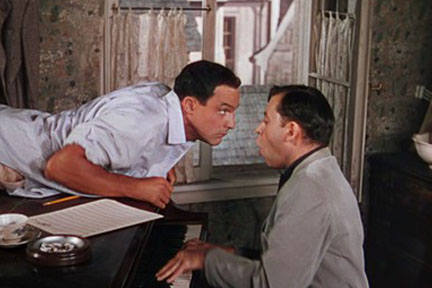
There is certainly exuberance to Jerry Mulligan’s character, played with such joie de vivre by Gene Kelly. Without a doubt he has to be the most cheerful starving artist in all of Paris. His perfect foil is his friend, Adam (Oscar Levant) an equally struggling artist who dreams of playing the concert piano. He is the wisecracking contrarian through whom Mulligan learns of the young French girl Lise, played by Leslie Caron in her film début. If there is any depth to the plot, it is to be found here with Lise falling for Jerry who in turn falls for her while concurrently being wooed by society woman, Milo Roberts (Nina Foch) who wishes to sponsor Jerry’s paintings. But Lise is engaged to Henri a cabaret singer played by Georges Guétary. Unwittingly then, Henri and Jerry are after the same girl. Ooo-la-la!

Jerry and Adam tra-la-la-ing in Adam's garret apartment.
While everything is sewn up rather quickly but unconvincingly during the last minute of the movie -- is Henri really smiling while he watches Lise leave his cab for Jerry waiting for her at the top of the steps? Whatta chump! -- the real reason the film is a hit is of course because of the music and dancing. Kelly does things with his feet and body that look so effortless and natural one almost believes he always moved that way. The amusing little vignette at the beginning where he “rearranges” his tiny garret apartment from his sleeping quarters to his living quarters is a gem. The musical/dance numbers come fast and furious in this picture, and one should pay special attention to the fluid camera work in the “Tra-la-la” sequence. And there is something very cool about lighting those stair risers during the “I’ll Build a Stairway to Paradise” number, as Henri ascends them.

The final big number choreographed to Gershwin’s “An American in Paris” serves as the highlight of the picture. It is interesting to note the use of Caron’s ballet movements interspersed with Kelly’s natural dancing and how they made it work.

A worthy Best Picture winner for 1951, I still can’t for the life of me comprehend how the Academy offered a similar statuette to the next year’s winner: The Greatest Show on Earth!

--kak


Gene Kelly est très chaud


Yes, please...
Gene Kelly is hot. Never was there such a manly man to dance on the big screen. I read a brief bio on Kelly (we share the same birthday!) and he said his Mom made him and his brother take dance lessons when they were boys. They quit because the other kids called them sissies. But he said he went back to dance class at fifteen because he discovered it 
was a great way to get girls.


We watched An American in Paris last night. I’d never seen it before, nor did I even know what it was about except, well, Americans in Paris.

The story centers around Jerry Mulligan (Kelly) who stays in Paris when he gets out of the service after World War II. He decides he wants to try his hand at painting and reasons the best place in the world to do this is Paris. He lives in a tiny garret apartment next door to his buddy Adam Cook (played by composer and actor Oscar Levant), another American and concert pianist who is always preparing for a concert, but never actually performs. They are both scraping to make ends meet and living the starving artist lifestyle.

Ms. Roberts checks out the merchandise... and the paintings.
There are two central plots that intertwine in this film. One is about Jerry, his art, and the wealthy patroness that wants to keep him in her pocket. The other is about Lise (the debut for pixie-faced Leslie Caron), a shop girl who catches Jerry’s eye at a club and he pursues with great persistence. Lise is already engaged, but keeps this information from him as they fall in love. Of course, broken hearts and disaster ensues, but it’s a musical from the fifties, so you know it has a happy ending.

Gene Kelly is hot. Oops, I said that already, didn’t I? Not only that, but extremely talented and creative. He did all the choreography for this picture and it was incredible. In 1928 George Gershwin wrote a “symphonic tone poem” with the same title and is used as the music for the grand finale of the film: a seventeen minute ballet performed in a picture drawing set in the City of Light.

I loved the look of this movie. Like My Fair Lady, it was completely filmed on sound stages in Hollywood, but MGM did a much better job. They knew it was going to look like a set so they created an almost painterly feel to it. The color palette was vibrant: lots of reds and oranges mixed with dark teal, blues and soft gray. It was almost as if one had stepped into one of the paintings Jerry Mulligan was trying to sell on the street in the Montmartre. And indeed, the ballet was a vision Jerry has where we are sucked right into one of his sketches. The whole aesthetic of the film is a dreamy, fairytale quality. But a jazzy fairy tale, with lots of Gershwin hits and fabulous dance numbers.

With such elfin looks, I wouldn't be surprised
if she were hiding pointy ears.
I love watching dancers. There is something so pure out of making art with your body as the tool. And Gene Kelly is so good: athletic, graceful, and did I mention hot? He makes even the toughest moves look easy and makes me want to try dancing again… almost.
Leslie Caron was charming. Her impish looks and fluid grace make her a pleasure to watch. And then there’s the cute little accent which makes her attempts to tell off Jerry Mulligan downright adorable. She’s quite a dancer too, and she and Gene are matched very well as partners.

I would be remiss if I didn’t mention how much I liked Oscar Levant as Adam Cook. He kind of reminds me of John Cryer and he was the comic relief. My favorite scene was when he is sitting between Jerry and the French singer, Henri Baurel. Both are talking about the women they are in love with and Adam is practically choking on his cigarette and coffee because he realizes they are the same girl.

No room for anything but happy.
I loved this movie. There is something about it that makes me want to grand jeté down my street. Maybe it’s because of the music. Maybe it’s because Gene Kelly is always so dang happy, and joy just beams out of his face like a searchlight when he’s dancing. This would be a great movie to watch on a rainy day, or when you’re feeling sad. It's got everything you need for a boost: technicolor, jazz, snappy dancing, and a happy ending.

And Gene Kelly is hot.

~Anna

Next up: Rain Man (1988)

Monday, July 4, 2011

My Fair Lady


My Fair Lady (released December 25, 1964)
Director: George Cukor
Starring: Audrey Hepburn, Rex Harrison, Stanley Holloway, Gladys Cooper
Produced by: Jack Warner
Written by: Alan Jay Lerner, George Bernard Shaw
Music by: Frederick Loewe (music), Alan Jay Lerner (lyrics)
Cinematography by: Harry Stradling, Sr.
Distributed by: Warner Bros.


Lady Fair

Really? Another musical to review? We just got finished writing about The Sound of Music didn’t we…? Okay, maybe that was a while back, but I was still slightly astounded to discover this film being pulled from the box on the heels of the Von Trapp adventures in Austria. I must admit that for someone who is not a big movie musical fan, I have caught myself humming tunes from My Fair Lady from time to time throughout my life. I will even admit to crooning some verses along with the CD player in an old friend’s rebuilt Camaro as we sped across miles and miles of open searing desert in the American Southwest while on a road trip a few years back. Richard happily possesses a fine voice, and I can only imagine the astonishment of the Navajo people and Gila monsters on the sides of the road as we raced by and they caught snatches of “The Rain in Spain”.


It fell to Warner Bros. and director George Cukor to bring this iconic stage musical to the big screen. In general, the look of the film was stagy; no doubt this due to its production on the Warner soundstages in Burbank, and because of this, in my opinion it really didn’t have the right “Edwardian English” look and feel to it. I believe it would have helped deflect bit of the disappointment many people felt in not seeing the original Eliza Doolittle of the stage version (Julie Andrews) in the title role instead of Audrey Hepburn. However at the time, Audrey had earned her chops before the cameras and Julie had not, and upon such fine points of cinematic etiquette film classics blossom and flourish or wither and die.

Erm, the street where you live looks like a sound stage...

I suppose we can’t find much to carp about Miss Hepburn’s lip-synching when in the same production we have Mr. Rex Harrison’s half-spoken, half-sung renditions, but then again he never claimed he could sing and indeed, his delivery managed with such bravado, comes across as quite natural. This, one imagines, is how the puritanical Henry Higgins would sing if forced to do so. At any rate, it certainly worked for him on the stage in London for those oft-repeated performances… 


This singing gig is a breeze!

And speaking of singing, it still startles me a bit to see the late and venerable Jeremy Brett warbling “On the Street Where You Live” as the rather foppish suitor for Eliza’s hand, Freddy Eynsford-Hill. Sherlock Holmes would never chase after a woman like that would he? 

Freddy never used his powers of deduction
to discover he was a git.

And yet despite these admittedly trivial cavils (which however added together leave one with a less-than-enthusiastic overall feel for the film) I did enjoy watching this version of what has been termed “the perfect musical”. The story in whatever guise one approaches it; ancient Greek myth, 19th Century play, or 20th Century musical has all the charm, freshness and sophistication of a classically good story.


I have sometimes mused upon what an indescribable rush of perfect joy Lerner & Loewe must have experienced when they originally came up with the pairing of words to music, being the only two in the world at that moment to know that they had just created something of true magnificence. 

--kak


My Unfairly Treated Lady

Audrey... practically
perfect in every way.


I love Audrey Hepburn. I want to look like her – lithe, graceful, with a swan’s neck, and huge eyes fringed in dark lashes. The few men I’ve told this to don’t get it. They tell me she’s got a big nose, no tits, and is too skinny. But I don’t care… there is something about her smile and voice that convinces me that she’s never been anything but happy. 


It’s nice little fantasy.

I was excited to watch My Fair Lady. It isn’t one I’d seen as a kid – we seemed to be a Rodgers and Hammerstein household and not a Lerner and Loewe one.  I figured I’d be in for a treat. It has Audrey Hepburn, gorgeous clothes, and some great music. What’s not to love?

Have you got an hour?

Let’s start by comparing and contrasting it with The Sound of Music. Both originated as stage plays, and while the movie version of SOM is visually gorgeous (how can it not be filmed in Salzburg?), I felt MFL was still very much a stage play. All outdoor scenes were obviously filmed on a soundstage. Maybe that was the look the director was going for, I don’t know. I do know that it seemed less authentic to me.

The music was great. Lerner and Loewe are no slouches when it comes to writing catchy songs that could crawl into your ear and burrow into your brain. (But in a good way.) My husband can do all of Henry Higgins’ parts from memory. I have to admit that’s awfully cute.

A prisoner of the gutter

Now let’s talk about the story. Henry Higgins is an English gentleman (and that’s figuratively, not literally) who says the only thing separating the classes is a lack of education and proper speech. (I suppose he'd consider it crass to mention something as inelegant as MONEY.) He picks Eliza Doolittle, a lowly flower seller and bets with his buddy Colonel Pickering, that he could pass her off as a lady with a bit of training up. He plucks her from the mud of Covent Garden and installs her in his townhouse. Surely a stroke of luck for poor, dirty, ignorant, uneducated Eliza, right?

All right, here’s the poop: this plot makes me itch. It makes me fume, steam, and rage. I am completely disgusted with the character of Henry Higgins, who sees Eliza Doolittle not even as a human being. He takes all the credit for her hard work, and never once considers Eliza has feelings, intelligence, or even a pulse. I find Eliza Doolittle to be delightful – funny, sharp, and full of spirit. After Henry has won his bet, he doesn’t see he has ruined her: she’s not really a lady and can’t ever belong in high society, and she can't return to her former life because she'd be resented for trying to rise above her station. She is a human being trapped in the ether without a place in the world.


In short, Henry Higgins is a worm.


G.B. Shaw: satirist or worm?
My problem stems from the source of this musical: George Bernard Shaw. He wrote Pygmalion, the play upon which My Fair Lady was based. I don’t know enough about him to understand if he intended this as a piece of satire. Or was Henry Higgins’ world view his own? Either option is a bad one. If he wrote it as a biting piece of satire, what would possess a person to set it to jaunty music? The theme and style of the film are at extreme odds with each other. I feel like I’m chewing aluminum foil while watching it. But on the verso, if Shaw was just as much of a worm as Henry Higgins, why do people find this a charming story? It has been venerated as “the perfect musical.” But how can you call it that when it is full of despicable characters, classism and misogyny? It makes me want to scream. And I am. Right now. In my head.

And the ending? If they were still alive, I’d hunt down the parties responsible and smack them with Henry’s slippers for that kind of ambiguous crap. But that’s just me. 

~Anna


Up next: 1949's All the King’s Men